

With an estimated 39.6 million wood mice across the UK, it is little wonder that British gardeners are noticing a sharp rise in nibbled bulbs and missing seeds. Learning how to keep mice out of garden uk spaces has become a priority for those who want to protect their hard work without resorting to methods that harm the local ecosystem. It's frustrating to invest time and money into your borders only to find them decimated overnight. You likely want a solution that works but feel rightly anxious about the risks of secondary poisoning to birds of prey or the legal restrictions surrounding traditional traps.
This guide focuses on ethical, non-toxic deterrents that safeguard your garden perimeter while respecting the Animal Welfare Act 2006. We promise to show you how to manage animal behaviour through sensory signals rather than elimination. You will learn about practical habitat changes and sustainable, proven methods that offer peace of mind for your pets and the wider environment.
Key Takeaways
- Identify common signs of Wood Mouse activity, such as hollowed-out bulbs and nibbled stems, to address the issue before it spreads.
- Understand the ethical and legal benefits of sensory deterrence over lethal traps to protect local owls and birds of prey.
- Learn how to keep mice out of garden uk spaces by organising nesting sites and managing bird feed to remove natural attractants.
- Discover why durable, clay-based granules offer a more reliable, long-term barrier than temporary liquid scents or essential oils.
- Establish a sustainable, non-toxic management plan that ensures the safety of your pets and the surrounding British wildlife.
Recognising the Signs and Reasons for Mice in British Gardens
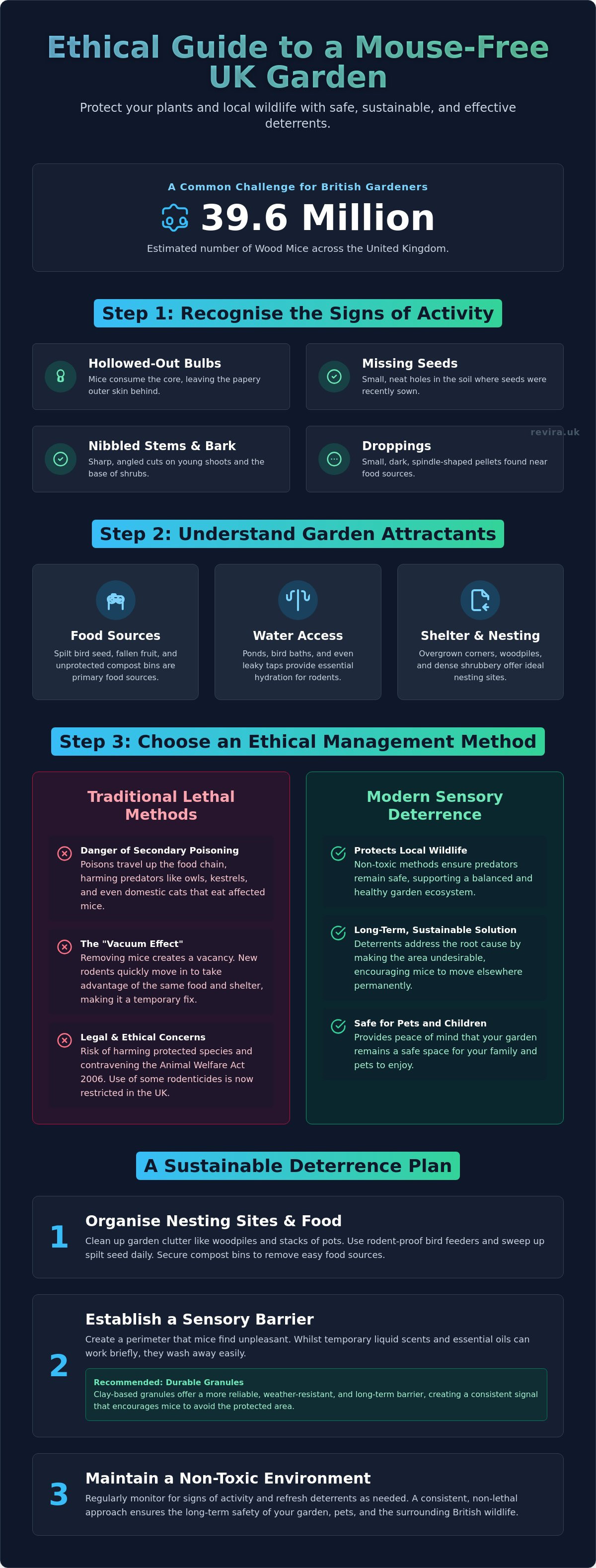
Mice are masters of invisibility. You might not see them, but their impact on a British garden is unmistakable. If you've ever found your prized tulip bulbs hollowed out or your freshly sown pea seeds missing from their rows, you're likely dealing with a rodent visitor. Understanding how to keep mice out of garden uk borders begins with accurate identification. Whilst these small mammals are a vital part of the local food chain, their presence amongst young crops can be destructive. With an estimated 39.6 million wood mice in the UK, they're a common neighbour for most gardeners.
Identifying Wood Mice vs. Field Mice
The most frequent visitor to UK gardens is the Wood Mouse, often referred to as the Field Mouse. They have large, prominent ears and long tails that equal their body length. Their coats are typically a warm sandy brown with a white underside. In contrast, the common House Mouse is often greyer and more likely to seek permanent residence inside your home. For a deeper look at House mouse behaviour and biology, research indicates they are highly adaptable foragers. Whilst most garden mice aren't protected, you should be aware that species like the harvest mouse or dormouse have strict legal protections under UK law. Identifying your visitor is a vital first step in responsible management.
Mice leave specific clues that help you confirm their presence. Look for these signs around your plants and structures:
- Hollowed-out bulbs: Mice often eat the centre of a bulb and leave the papery outer skin behind.
- Missing seeds: Neat, small holes in the soil where a seed was recently planted.
- Nibbled stems: Sharp, angled cuts on young shoots or the bark of woody shrubs.
- Droppings: Small, dark, spindle-shaped pellets often found in clusters near food sources.
Why Your Garden is a Favourite Habitat
Your garden is a sanctuary. It provides three things every mouse needs: food, water, and shelter. Bird feeders are a primary attractant. Spilt seeds on the ground act as a dinner bell for local rodents. Garden clutter, such as old woodpiles, stacks of pots, or overgrown corners, offers perfect nesting sites. Activity usually peaks during autumn and winter. As temperatures drop, mice move closer to human structures and cultivated areas in search of warmth and stored calories. By recognising these patterns, you can begin to organise your space to be less inviting without causing harm to the animals. Understanding how to keep mice out of garden uk environments is about managing these resources effectively to encourage them to move elsewhere.
The Ethical Case for Deterrence over Lethal Pest Control
Choosing a management strategy for your garden is about more than just protecting plants. It is an exercise in environmental responsibility. Many traditional methods rely on lethal force or chemical interventions that ripple through the local ecosystem with devastating effects. As of July 4, 2024, the outdoor use of Second Generation Anticoagulant Rodenticides (SGARs) is strictly limited in the UK due to these very risks. When you look for how to keep mice out of garden uk spaces, the most effective long-term approach is one that works with nature rather than against it. By choosing sensory deterrence, you ensure your garden remains a safe haven for all wildlife, including the predators that naturally keep rodent populations in check.
The Danger of Secondary Poisoning to Local Wildlife
The use of rodenticides creates a dangerous cycle of secondary poisoning. When a mouse consumes toxic bait, it doesn't die instantly. Instead, it becomes slow and easy prey for owls, kestrels, and domestic cats. According to RHS advice on mice and voles, these small mammals are a primary food source for many garden visitors. If the prey is toxic, the predator suffers. Second-generation anticoagulant rodenticides are designed to be persistent; they accumulate in the liver of any animal that consumes the bait or a poisoned rodent, leading to lethal concentrations higher up the food chain. This bioaccumulation threatens the very biodiversity that makes a British garden thrive. Choosing a non-toxic deterrent protects these vital species whilst keeping your flowerbeds intact.
Why Traps Often Fail to Solve the Root Problem
Physical removal rarely provides a permanent solution because it ignores the "Vacuum Effect." When a mouse is removed from a territory, the available food and shelter remain. This creates a vacancy that is quickly filled by another individual from the surrounding area. Traps also bring a significant logistical burden. Humane live-capture models require monitoring every few hours to prevent the animal from dying of stress or dehydration. Furthermore, the Glue Traps (Offences) Act 2022 made the use of glue traps by the general public illegal in England as of July 2024, reflecting a clear legal shift toward more compassionate methods.
Deterrence addresses the underlying attractiveness of your garden. Instead of a cycle of trapping and replacement, sensory barriers send a clear signal that the area is inhospitable. This encourages mice to establish their nests elsewhere, away from your vulnerable seedlings. It is a proactive, low-maintenance strategy that avoids the stress of handling live animals or the grim task of disposing of carcasses. By focusing on how to keep mice out of garden uk areas through behaviour modification, you achieve a sustainable balance that protects your property and your conscience.
Strategic Garden Maintenance to Discourage Rodent Nesting
An organised garden is your first line of defence. When considering how to keep mice out of garden uk spaces, the focus should shift from removal to prevention. Mice thrive where they feel safe and well-fed. By systematically removing nesting sites and food sources, you create a landscape that is naturally less attractive to rodents. This is not about creating a sterile environment; it is about guiding wildlife towards more appropriate habitats away from your vulnerable plants and structures. A few strategic changes to your daily gardening habits can significantly reduce the appeal of your outdoor space.
Managing Compost and Bird Feeders Correctly
Bird feeders are often the primary reason mice frequent a specific area. To mitigate this, elevate your bird tables and install seed catchers to prevent grain from reaching the floor. Mice are agile, but they are less likely to stay if their nightly forage yields no results. Similarly, compost bins should be secured. Lining the base and sides with heavy-duty wire mesh prevents mice from burrowing up into the warmth of the decaying organic matter. For storage, always use galvanised metal containers for grass seed and pet food. Mice can easily chew through plastic bins, but metal provides a permanent, impenetrable barrier that keeps food sources out of reach.
Consider these practical adjustments for your garden storage:
- Clear clutter: Remove stacks of empty pots and old timber piles that provide instant shelter.
- Secure the shed: Check for small gaps at the base of doors and use wire wool or metal plates to seal them.
- Manage water: Ensure water butts have tight-fitting lids to prevent rodents from being drawn to easy water sources.
Choosing the Right Mulch and Ground Cover
The materials you use for ground cover significantly impact rodent activity. Thick straw mulch provides warmth and excellent burrowing conditions, making it a favourite for nesting mice. Opt instead for gravel or bark chips. These materials are less stable for tunnel structures and offer far less insulation. Maintaining a clear buffer zone, such as a strip of bare earth or gravel, between your garden beds and the walls of your home or shed is also effective. This removes the corridors of dense vegetation that mice use to move unseen. Without this cover, they feel exposed to natural predators and are less likely to linger. Understanding how to keep mice out of garden uk environments requires this blend of tidiness and tactical landscaping to ensure your garden remains protected throughout the year.
Utilising Scent and Sensory Barriers for Natural Protection
Mice rely heavily on their sense of smell. Their olfactory system is far more sensitive than a human's, allowing them to detect food sources and potential threats from significant distances. If you are looking for how to keep mice out of garden uk beds, leveraging this sensitivity is an intelligent, non-invasive strategy. By introducing specific scent markers, you can communicate a danger signal that encourages rodents to avoid your property altogether. This method doesn't require physical barriers or harmful chemicals; it simply changes the animal's perception of the space.
Natural Scents and Plants That Discourage Mice
Many gardeners use plants like Alliums, Lavender, and Mint to create a soft perimeter of discouragement. Whilst these are pleasant for us, their strong aromatic profiles can be overwhelming for a mouse's sensitive nose. However, plants alone are rarely enough for a determined population. Some homeowners turn to electronic ultrasonic devices, but these often fail in complex garden layouts. Sound waves are easily blocked by sheds, fences, and dense foliage, leaving blind spots where mice can still thrive. A more reliable approach is a scent barrier that permeates the air and soil, altering the rodents' perceived territory.
Consider these scent-based factors in your garden:
- Aromatic borders: Planting strong-smelling herbs can act as a minor deterrent for casual foragers.
- Sensory overload: Concentrated scents can disrupt a mouse's ability to track food or detect predators.
- Perceived risk: Specific scents signal the presence of a threat, triggering a natural flight response.
Disrupting Established Pathways and Territory
Mice are creatures of habit. They use specific runs or pathways, usually along the base of fences, walls, or hedgerows where they feel secure from aerial predators. Disrupting these established routes is key to long-term success. By placing sensory deterrents directly on these runs, you force the mice into more exposed areas of the lawn or garden. This increased vulnerability makes them feel unsafe, prompting them to relocate their nesting sites.
Consistency is vital. Temporary solutions like peppermint oil or diluted vinegar are often recommended in DIY forums, but they have a significant weakness: the British weather. These liquids evaporate quickly or wash away during a typical rain shower, requiring constant reapplication to remain effective. For a more durable solution that withstands the elements, consider a professional-grade product like Revira mice and rodent deterrent. This ensures the scent signal remains strong and clear, providing the persistent discouragement needed to change rodent behaviour for good. Understanding how to keep mice out of garden uk landscapes is ultimately about creating a sensory environment where rodents simply do not want to be.
Implementing a Long-Term Deterrence Strategy with Revira
Establishing a permanent solution for how to keep mice out of garden uk spaces requires more than just temporary fixes. Revira provides a professional-grade, non-toxic deterrent specifically designed for the British climate. Unlike essential oils or home remedies that fail at the first sign of rain, this approach uses sensory signals to create an invisible boundary. It is a method that respects the life of the animal whilst firmly protecting your property. By moving away from the constant monitoring required by live traps, you gain a reliable system that works quietly in the background. This allows you to maintain a productive, beautiful garden that exists in harmony with the local environment.
How Clay-Based Deterrent Granules Create a Protective Shield
The efficacy of Revira lies in its delivery system. The deterrent uses natural clay granules as a carrier for specific scent markers that mice and voles associate with danger. When these granules are spread, they emit a consistent signal that discourages rodents from entering the treated area. Because the scent is bonded to the clay, it is highly weather-resistant. Whilst essential oils are easily diluted by the frequent British rain, these granules are designed to hold their scent profile for an extended period. These clay-based granules consist of natural materials that are entirely non-toxic to the soil and surrounding ecosystem. This makes them perfectly safe for use in gardens frequented by pets, children, and protected local wildlife like hedgehogs.
Application Tips for Year-Round Garden Safety
Success depends on correct placement. To protect a vulnerable flower bed or vegetable patch, apply a 10-15cm wide barrier of granules around the entire perimeter. This creates a sensory "no-go" zone that rodents are reluctant to cross. This strategy is particularly effective for how to keep mice out of garden uk hotspots where rodents typically seek shelter or food. Focusing your efforts on these areas ensures maximum protection with minimum product waste.
Consider applying the barrier in these specific locations:
- Sheds and outbuildings: Apply around the external base to prevent rodents from nesting underneath the floorboards.
- Greenhouses: Create a perimeter to protect young seedlings and stored bulbs from overnight foraging.
- Poly-tunnels: Secure the entrance and side flaps where mice often slip inside to escape the cold.
Regular maintenance is simple. You don't need to reapply after every shower. Instead, monitor the barrier and refresh it as the granules eventually break down into the soil. This provides a sustainable, long-term wildlife management plan that gives you peace of mind. You can finally enjoy a productive garden without the anxiety of secondary poisoning or the frustration of failed traps. Protect your garden humanely with Revira Mice & Vole Deterrent.
Cultivating a Secure and Ethical Garden Environment
Protecting your outdoor space doesn't need to involve conflict with the natural world. By integrating tidy gardening habits with advanced sensory barriers, you create a sustainable environment where your plants can thrive. You now have the knowledge to identify wood mouse activity and the practical steps to remove the shelter and food sources that draw them in. Mastering how to keep mice out of garden uk landscapes is a journey toward a more balanced, responsible way of gardening that prioritises long-term results over quick, harmful fixes.
Revira provides a dependable solution that is proven against mice, voles, and badgers. The 100% non-toxic formula ensures your pets, children, and local birds of prey are never at risk from secondary poisoning. Unlike temporary oils or DIY sprays, this long-lasting protection remains effective throughout the damp British seasons, giving you the reliability you need to protect your bulbs and seedlings year-round.
Explore the Revira range of ethical garden deterrents to secure your borders with quiet confidence. Your garden can be a productive, beautiful sanctuary that respects the delicate balance of the British ecosystem.
Frequently Asked Questions
What smells do mice hate the most in the garden?
Mice have a highly sensitive sense of smell and actively avoid strong, pungent aromas such as peppermint, lavender, and eucalyptus. Whilst these natural oils provide a soft deterrent, they often require frequent reapplication after rainfall. For a more durable solution, professional-grade clay granules provide a persistent scent signal that mimics the presence of a threat, encouraging rodents to seek territory elsewhere.
Is it legal to catch and release mice in the UK?
It is legal to catch and release mice in the UK, but you must ensure you don't breach the Animal Welfare Act 2006. Releasing a mouse into an unfamiliar environment often leads to its death through exposure or predation. It is far more compassionate to use deterrents that prevent the mouse from nesting in your garden in the first place, avoiding the stress of capture and relocation.
Do ultrasonic mouse repellers actually work in large gardens?
Ultrasonic repellers are often ineffective in large or complex gardens because sound waves cannot travel through solid objects. Fences, garden sheds, and dense shrubbery create "sound shadows" where mice can still hide and forage safely. For comprehensive coverage, sensory deterrents that rely on scent are more reliable as the aroma can permeate through foliage and around structures.
Can mice damage my lawn or is it likely to be voles?
Damage to your lawn is typically caused by voles rather than mice. Voles create distinctive surface tunnels and "runs" through the grass, whilst mice are more likely to target your vegetable patch or flower beds. If you see neat, narrow paths on the surface of the turf, you are likely dealing with bank or field voles.
How do I stop mice from eating my spring bulbs?
To protect your spring bulbs, you should place a physical barrier like chicken wire over the planting area or use a sensory deterrent. Learning how to keep mice out of garden uk flower beds involves creating an environment where the reward of the bulb isn't worth the perceived risk of the area. Planting bulbs deeper or using deterrent granules around the perimeter of the bed provides effective, non-lethal protection.
Will having a cat in the garden keep the mice away?
A cat can act as a natural deterrent, but it is rarely a complete solution for a garden population. Mice are nocturnal and highly cautious, often staying in areas that are inaccessible to a cat, such as beneath decking or inside wall cavities. The scent of a predator may discourage them briefly, but it won't remove the primary attractions of food and shelter.
What is the most humane way to deal with a mouse infestation?
The most humane approach is a combination of habitat management and sensory deterrence. Start by removing easy food sources like spilt birdseed and securing your compost bins. Once you've removed the attraction, use a non-toxic deterrent to signal that the garden is no longer a safe or hospitable place to nest. This encourages the mice to move on of their own accord without any physical harm.
Are mouse deterrents safe to use around dogs and cats?
Non-toxic, clay-based deterrents are perfectly safe for use around domestic pets like dogs and cats. Unlike chemical rodenticides, which carry a significant risk of secondary poisoning if a pet consumes the bait or a poisoned rodent, sensory deterrents work through smell alone. This provides a secure way to manage your garden whilst ensuring the safety of your family pets and local wildlife.